
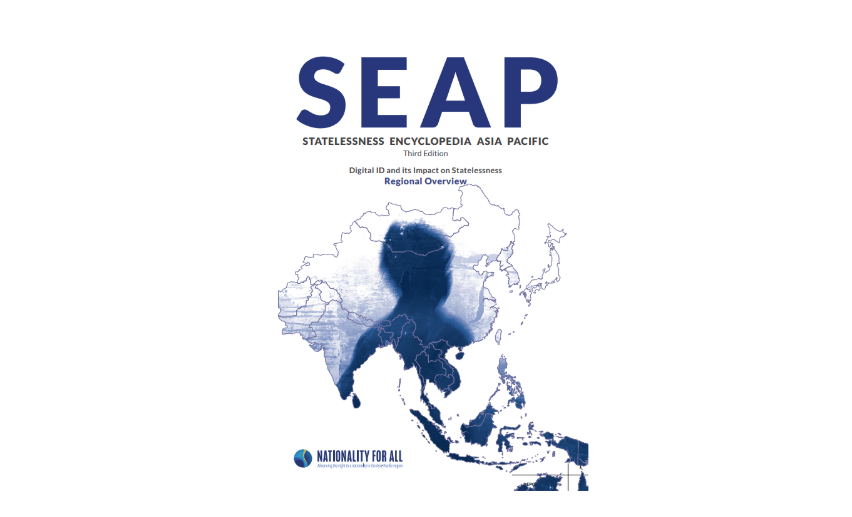
Global Statelessness Fund grantee partner Nationality for All (NFA) has launched the third edition of the Statelessness Encyclopedia Asia Pacific (SEAP), turning its attention to an increasingly important question: as identity systems become digital, who risks being left behind?
Across Asia and the Pacific, governments are increasingly using digital identity systems to modernise public administration and expand access to services. While these systems have the potential to make services more efficient and accessible, NFA’s research shows that digitalisation does not automatically mean inclusion. Without human rights and non-discrimination built into their design, digital ID systems can reproduce, and even amplify, inequalities already embedded in civil registration and legal identity systems.
For stateless people, the problem can begin before they ever reach a digital platform. Access to digital ID frequently depends on already possessing foundational documents such as a birth certificate, national identity card or residence permit, precisely the documents stateless and undocumented people are disproportionately likely to lack. As more essential services move online, exclusion from legal identity can therefore become reproduced and entrenched at the digital level, affecting access to healthcare, education, social protection, banking, employment and other areas of everyday life.
When old barriers take new forms
These findings also resonate with learning emerging elsewhere across the GSF network. In Kenya, grantee partner Nubian Rights Forum (NRF) has reflected on how digitalisation can reproduce longstanding documentation barriers in new forms.
Although discriminatory vetting practices affecting Nubian, Somali and other minority communities have formally been abolished, NRF has observed that applicants with complex documentation histories may now have to navigate computerised systems that leave less room to explain the circumstances behind missing or contested documents. Their experience raises an important question: what happens when discrimination is removed from one administrative process, but the systems replacing it are built on the same histories of exclusion?
NRF’s experience also highlights why accessibility cannot be understood through technology alone. Their mobile registration work brings documentation services and paralegal support directly to communities, helping reduce practical obstacles such as transport and application costs. In one recent drive, the organisation reached 836 people, with obtaining birth certificates being the service most frequently requested.
Together, this points to a simple but important lesson at the heart of NFA’s research: digitalising an unequal system does not automatically make it more equal.
Building a wider movement around digital inclusion
The connection becomes even stronger through GSF partner organisation, the Global Movement Against Statelessness (GMAS), has already been convening in the field specifically around the hidden harms of digital ID.
In June 2026, GMAS, together with regional statelessness networks, convened The Black Box: Statelessness and the Hidden Harms of Digital ID, bringing together different regional perspectives and lived experiences to examine how digital systems can embed barriers into the very infrastructure that determines recognition, documentation and access to rights.
The discussion created space for affected communities, advocates and organisations working across different contexts to compare how digitalisation is unfolding in practice, identify shared risks and consider how collective advocacy can help ensure that new identity systems do not reproduce existing forms of exclusion.
Together, this work shows how different parts of the statelessness movement can reinforce one another: NFA is building the regional evidence, organisations such as Nubian Rights Forum are showing how these changes are experienced by communities in practice, and GMAS is creating spaces for those experiences and lessons to travel across borders and shape collective responses.
Building the evidence for inclusion
Through the third edition of SEAP, NFA brings these emerging questions into a comprehensive regional resource. SEAP now includes 48 country factsheets, five sub-regional overviews covering Central Asia, East Asia, South Asia, Southeast Asia and the Pacific, and an Asia-Pacific regional overview.
The research does more than identify risks. It asks what more inclusive systems could look like, from ensuring universal birth registration and recognising alternative documentation pathways, to maintaining non-digital alternatives and building safeguards for people who cannot obtain conventional digital credentials. NFA’s analysis stresses that accessibility and non-discrimination need to be considered at the design stage, rather than addressed only once people have already been excluded.
For the Global Statelessness Fund, these connections across organisations and regions matter. Supporting affected-community-led organisations and the wider statelessness movement helps bring together regional research, lived experience and collective advocacy. It creates opportunities to identify emerging forms of exclusion early and to push for technological change that expands access and rights rather than carrying existing inequalities into new systems.
As governments build the identity infrastructure of the future, the question should not only be how quickly or efficiently systems can become digital, but who they are designed to include and who gets to shape them.
About Nationality for All
Established in 2020 from the work of the Statelessness Network Asia Pacific, Nationality for All is a regional organisation working to advance the right to nationality across Asia and the Pacific. NFA combines research, advocacy, partnership-building and movement strengthening, while promoting the leadership of people with lived experience of statelessness and nationality discrimination.
Explore the third edition of the Statelessness Encyclopedia Asia Pacific and Nationality for All.