
Global Statelessness Fund grantee partner Youth Sustainable Development Centre (YSDC) recently brought concerns around statelessness and gender discrimination in Eswatini’s nationality laws to the 53rd Universal Periodic Review (UPR) Pre-Sessions in Geneva.
The Pre-Sessions provide civil society organisations with an international platform to brief representatives of recommending states before a country’s formal UPR review. Eswatini’s Pre-Session took place on 26 August 2026, where YSDC contributed through its own statement and presentation. Both are available on Eswatini’s 53rd UPR country page on UPR Info here.
For YSDC, the intervention created an opportunity to bring evidence from its work with affected communities into an international human rights space, highlighting how gaps in nationality law and access to legal identity are experienced in people’s everyday lives.
YSDC acknowledged progress made in Eswatini, including efforts to strengthen civil registration, while drawing attention to continuing inequalities in the country’s nationality framework. Its intervention focused particularly on gender discrimination in nationality rights, childhood statelessness and the barriers families can face in securing legal recognition and documentation.
The intervention was grounded in YSDC’s wider work on equal nationality rights and ending statelessness in Eswatini. Through community dialogues, advocacy campaigns, engagement with traditional and other stakeholders, and awareness-raising, YSDC works to ensure that the experiences of affected people inform conversations about legal and policy reform.
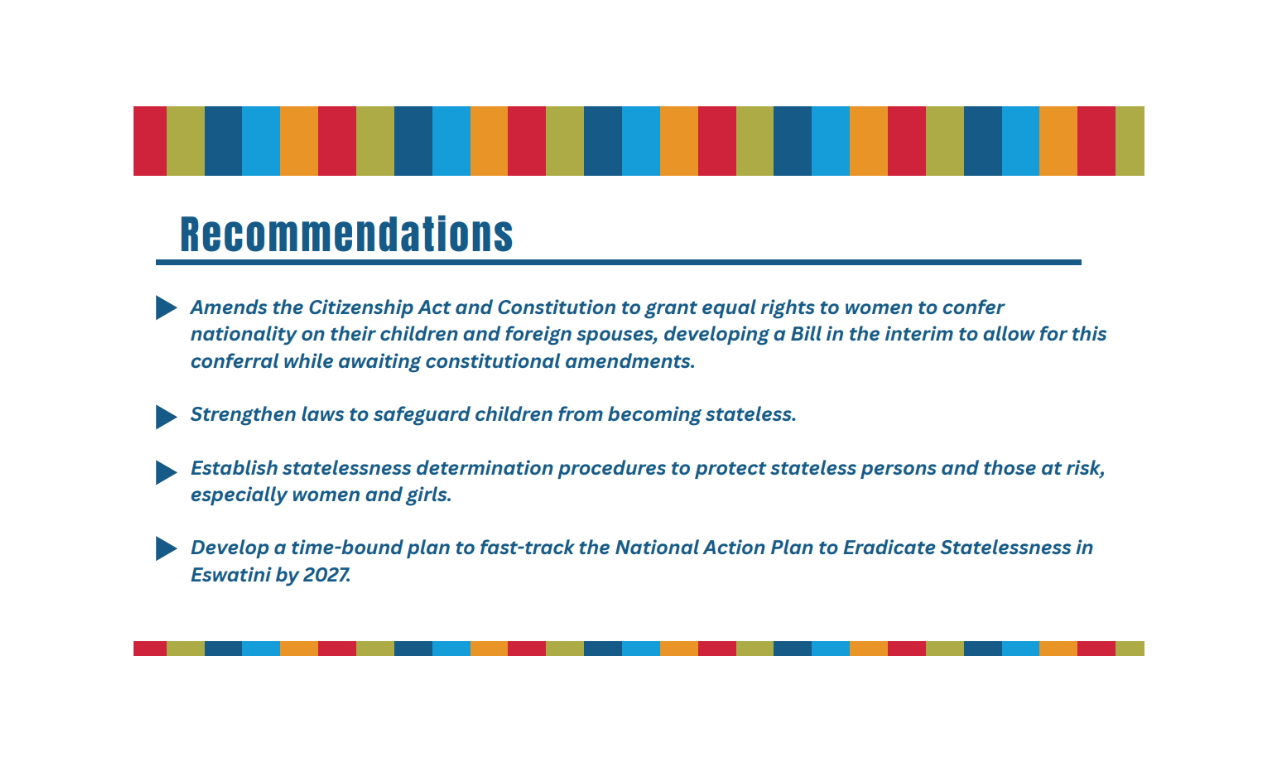
At the Pre-Session, YSDC used this experience to bring concrete recommendations into the UPR process, including calls for stronger gender equality in nationality law, safeguards against childhood statelessness and more effective measures to address statelessness in Eswatini.
Building on sustained advocacy
YSDC’s engagement with the UPR process also builds on several years of advocacy.
During Eswatini’s previous 39th UPR cycle in 2021, YSDC participated in a joint Pre-Session intervention alongside the Institute on Statelessness and Inclusion (ISI), the Global Campaign for Equal Nationality Rights, the Coordinating Assembly of Non-Governmental Organisations and the Southern African Human Rights Defenders Network. This intervention also focused on nationality rights, gender discrimination and the prevention of statelessness, which you can read here.
Five years later, YSDC returned to the Pre-Sessions with an intervention in its own name. This progression illustrates how international advocacy can develop over time, combining partnerships and shared expertise with increasingly grounded knowledge from organisations working directly with affected communities.
The next confirmed stage of Eswatini’s current UPR cycle is its formal review by the UPR Working Group on 6 November 2026. YSDC’s Pre-Session intervention took place ahead of that review so that its evidence and recommendations could be heard by state representatives during the advocacy phase of the process.
For the Global Statelessness Fund, supporting organisations such as YSDC is also about helping ensure that knowledge rooted in affected communities can travel from the local to the international level. Community engagement can reveal where nationality systems are failing in practice, while spaces such as the UPR Pre-Sessions provide an opportunity to turn those experiences into concrete recommendations for change.
About YSDC
Founded in 2020, the Youth Sustainable Development Centre is a youth-led and youth-focused organisation in Eswatini working to strengthen young people’s participation in sustainable development, human rights and decision-making. Its work focuses particularly on creating opportunities for young people, women and other groups facing exclusion.
Explore YSDC’s 2026 UPR Pre-Session statement and presentation, and learn more about YSDC’s work to advance equal nationality rights and address statelessness in Eswatini here.