
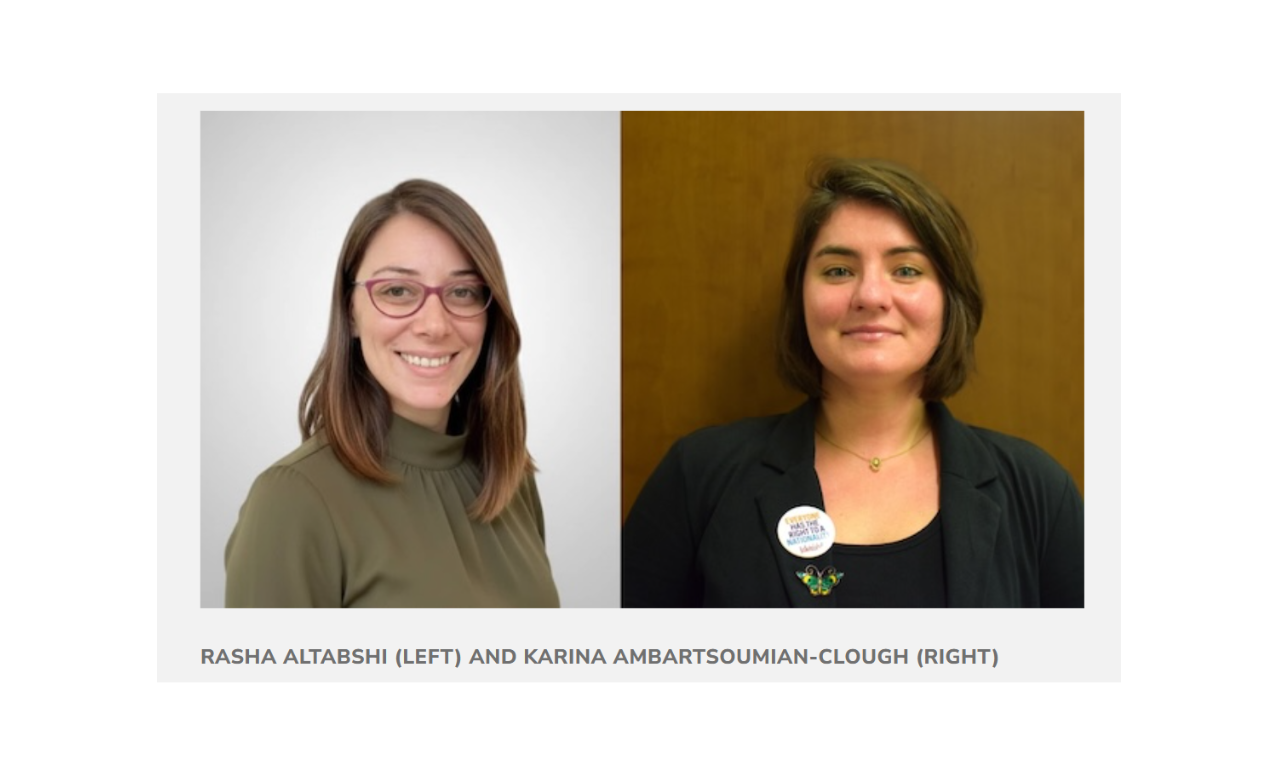
A recent article from the Women’s Refugee Commission, written by Global Statelessness Fund’s anchor partner, Catherine Harrington, Director of the Global Campaign for Equal Nationality Rights, brings together the experiences of two leaders from Global Statelessness Fund grantee partners: Rasha Altabshi, Executive Director of Warsheh Team, and Karina Ambartsoumian-Clough, Executive Director of United Stateless.
Rasha reflects on years of displacement from Syria and on how gender discrimination in Syrian nationality law shaped some of the most intimate decisions in her life. Because Syrian women do not enjoy the same rights as men to pass on nationality to their children, and because she and her husband were unable to legally register their marriage while displaced, Rasha faced the possibility that any children they had could be left undocumented and stateless. She describes how this legal uncertainty contributed to their decision not to have children.
Her experience illustrates how discriminatory nationality laws reach far beyond legal documents. They can shape family life, safety, mobility, financial independence and the ability to plan for the future. Rasha also draws attention to the particular impact displacement and insecure legal status can have on women, whose access to protection and independence may already be constrained.
Karina’s story shows another pathway into statelessness. After fleeing the Soviet Union with her family as a child and growing up in the United States, she discovered as a teenager that she was stateless. Without a recognised nationality, she experienced barriers to education, employment, healthcare and freedom of movement before later helping to establish United Stateless, an organisation led by people directly affected by statelessness.
Although their experiences unfolded in very different places, Rasha and Karina’s stories point to the same underlying reality: nationality is not simply a legal status. It shapes whether people can build families, access rights, move safely and feel recognised as belonging somewhere.
The article is also a powerful example of how lived experience can become leadership. Both women have transformed experiences of exclusion into sustained advocacy: Karina through stateless-led organising and legal and policy advocacy in the United States, and Rasha through Warsheh Team’s work challenging gender discrimination in Syrian nationality law and advancing the rights of women affected by statelessness and displacement.
For the Global Statelessness Fund, supporting organisations such as Warsheh Team and United Stateless means investing in female leadership rooted in lived experience. Their work shows why women affected by statelessness and discriminatory nationality laws must be able not only to tell their own stories, but to shape the organisations, strategies and reforms seeking to address them.
About Warsheh Team
Warsheh Team is a Syrian women-led organisation working to challenge statelessness and gender discrimination in Syrian nationality law. Through research, advocacy, community engagement and international advocacy, the organisation works to advance women’s equal right to pass on nationality and to address the consequences discriminatory nationality laws have for women, children and displaced families.
About United Stateless
United Stateless is a stateless-led organisation in the United States working to build community among people affected by statelessness and advocate for their human rights. Its work includes legal support, community engagement, training and federal advocacy aimed at expanding protection and recognition for stateless and unregistered people.
Read the Women’s Refugee Commission article, Meet two women working for the essential right to a nationality, and learn more about the work of Warsheh Team and United Stateless.