
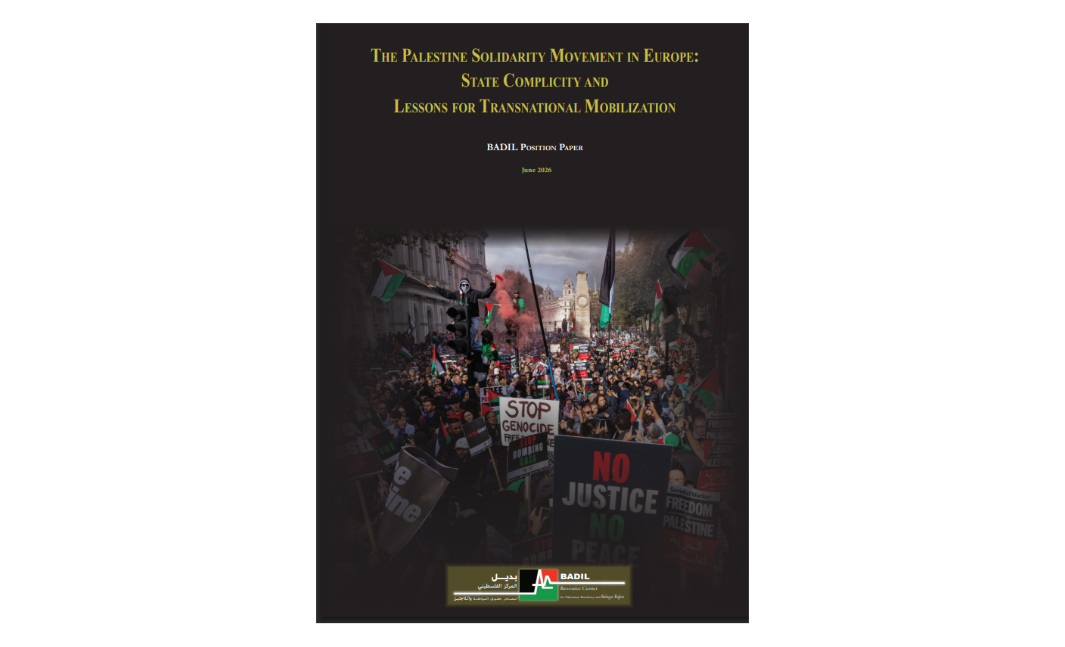
Global Statelessness Fund grantee partner BADIL Resource Center for Palestinian Residency and Refugee Rights has published The Palestine Solidarity Movement in Europe: State Complicity and Lessons for Transnational Mobilization, a new position paper examining more than two years of organising and collective action for Palestinian rights across Europe.
The scale of mobilisation has been remarkable. Drawing on available data, BADIL points to more than 45,000 demonstrations and events across approximately 800 cities in 25 European countries, alongside student organising, labour action, divestment campaigns, legal challenges and other forms of solidarity. The paper explores what these efforts have achieved, how European states and institutions have responded, and what lessons can be carried forward.
But BADIL also asks a more difficult question: how can widespread solidarity translate into sustained political change?
While recognising the movement’s achievements in building public awareness and collective pressure, BADIL argues that mobilisation has not yet resulted in the broader political, economic and institutional changes sought by the movement. The paper calls for deeper strategic reflection, including understanding where power lies in different national contexts, identifying effective pressure points and coordinating action across borders.
The report also highlights the importance of building connections across movements. BADIL points to alliances with labour, feminist, anti-racist, migrant justice, ecological and other social justice movements as important sources of collective power. Rather than solidarity remaining at the level of statements or isolated actions, the paper encourages movements to identify shared targets, coordinate campaigns and build sustained transnational strategies.
This work takes place within an increasingly challenging civic environment. Drawing on developments across Europe, BADIL also examines restrictions on Palestine solidarity activism, including protest bans, surveillance and constraints on advocacy and expression. For organisations and movements working within these conditions, the ability to reflect, organise and build relationships across borders becomes all the more important.
To make these lessons more accessible, BADIL has also developed multilingual brochures presenting the key findings of the position paper in English, Arabic, French, German, Italian, Portuguese and Spanish. Making the analysis available across languages helps the research travel beyond a single audience and become a practical resource for activists and solidarity movements working in different contexts. You can access the brochure here.
For the Global Statelessness Fund, supporting affected-community-led organisations such as BADIL means investing not only in advocacy, but in the space to think, connect and organise for long-term change. Movements need time to learn from experience, understand where power lies and build relationships that can carry collective action across borders. BADIL’s work shows how research can become a tool for reflection and strategy, helping communities move from documenting injustice towards building the collective power needed to challenge it.
About BADIL
Established in 1998, BADIL is a Palestinian human rights organisation led by refugees and internally displaced Palestinians. Rooted in the experiences and priorities of affected communities, BADIL works to advance the rights of Palestinian refugees and IDPs, including the rights to return, self-determination and protection from displacement and statelessness. Its work spans research, legal and international advocacy, community mobilisation, campaigns and youth engagement.
Read The Palestine Solidarity Movement in Europe and learn more about BADIL’s work.