
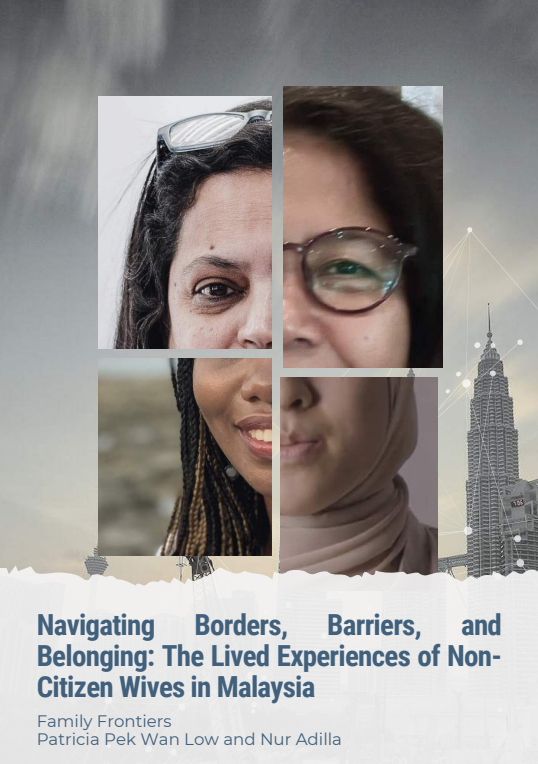
Global Statelessness Fund grantee partner Family Frontiers has published Navigating Borders, Barriers, and Belonging: The Lived Experiences of Non-Citizen Wives in Malaysia, a new report documenting how immigration and citizenship policies shape the everyday lives of women married to Malaysian citizens.
Centered on the experiences of non-citizen wives themselves, the research draws on focus groups and interviews with 62 women across Malaysia, alongside an online survey of 89 women. Their experiences reveal how complex immigration processes, restrictions on employment, dependency on Malaysian spouses, and uncertain pathways to permanent residence and citizenship can leave women with limited autonomy and at greater risk of gender-based violence.
Despite building families, living in Malaysia for many years and contributing to their communities, many non-citizen wives continue to face legal and political exclusion. The report highlights how the absence of clear and accessible pathways to permanent residence and citizenship can leave women treated as “perpetual outsiders”, even when their lives and families are firmly rooted in Malaysia.
Family Frontiers uses this evidence to call for concrete reforms. Among its recommendations are a clearer and more streamlined pathway to permanent residence; timely and transparent processing of citizenship applications for non-citizen wives under Article 15(1) of Malaysia’s Federal Constitution, equal rights to employment, and stronger protections for women whose marriages end through separation, divorce or widowhood. The report also highlights how improved access to marriage and birth registration can help reduce risks of statelessness and irregular status.
At its heart, the research shows that belonging is shaped not only by family and community ties, but by whether laws and systems recognise those ties in practice.
For the Global Statelessness Fund, supporting organisations like Family Frontiers is fundamental to advancing equal nationality rights. By bringing the lived experiences of affected communities into research, advocacy and policy discussions, organisations rooted in these issues can make structural inequalities visible and push for reforms that enable women and families to belong on an equal basis.
Read the full report and learn more about the work of Family Frontiers.
Family Frontiers, founded in 2009, is an organisation working to advance equal nationality rights, legal identity and the rights of binational families in Malaysia. Through strategic litigation, legal empowerment, parliamentary engagement, media advocacy and community support, the organisation works to address discriminatory nationality laws and bring about lasting change.
Led by women directly affected by discriminatory nationality laws, Family Frontiers has helped drive significant progress. This includes a landmark victory in 2025 securing Malaysian mothers’ right to pass citizenship to their children born overseas, a major breakthrough in the decades-long struggle for gender equality in Malaysia’s nationality laws.