
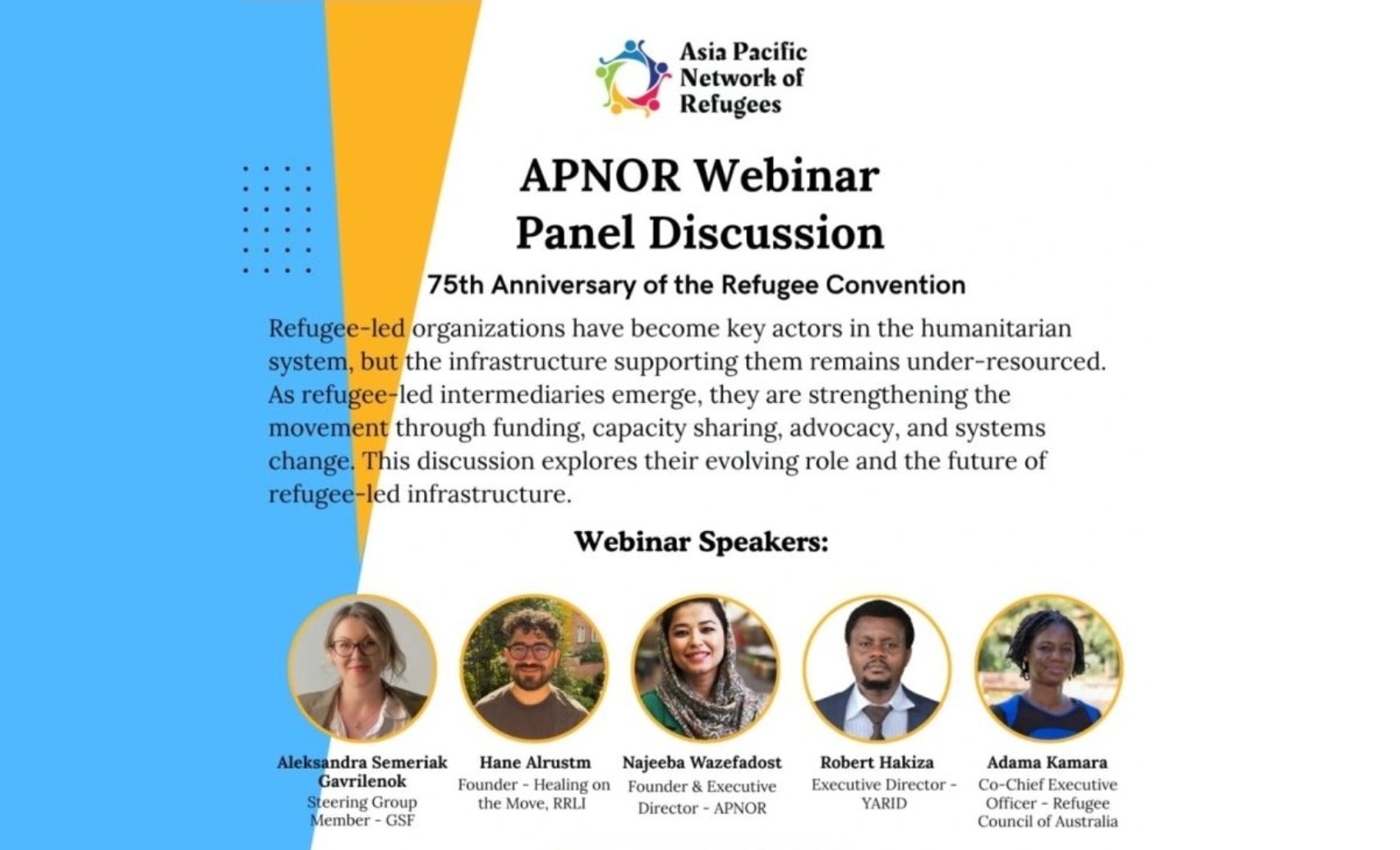
Our Steering Group member Aleksandra Semeriak Gavrilenok represented the Global Statelessness Fund on a panel discussion organized by the Asia Pacific Network of Refugees (APNOR) to mark the 75th anniversary of the UN Refugee Convention. The event, which took place on July 15th, was an opportunity to reflect on how far refugee leadership has come and what it will take to sustain it, including the role of refugee-led intermediaries. Other speakers included Najeeba Wazeefadost (APNOR), Hane Alrustm (Healing on the Move, Resourcing Refugee Leadership Initiative), and Robert Hakiza (Young African Refugees for Integral Development). The webinar was moderated by Adama Kamara (Refugee Council of Australia).
During the panel discussion, speakers all highlighted that the challenge in resourcing and strengthening refugee and stateless-led initiatives was not a lack of leadership. These organizations have long provided crucial support to their communities and advocated for legal change despite limited resources and significant structural barriers. Despite their critical importance, the very exclusion these initiatives are working to end also restricts their access to funding and resources due to requirements related to registration status, bank accounts, audited financial statements, and travel expectations. Refugee and stateless-led intermediaries, therefore, have an important role to play in connecting organizations to resources through flexible grantmaking and disbursement approaches, challenging traditional donor requirements, and helping shift accountability from donors to communities.
Because statelessness and its intersectionalities are often overlooked within the broader forced displacement field, intermediaries play a crucial role in increasing visibility and facilitating access to funds for underrecognised communities. Speaking on GSF’s role as a participatory grantmaker, Aleksandra Semeriak highlighted that participation is both a core value and a strategy for systems change. Impacted person-led grantees of GSF, including those that work at the intersection of forced displacement, do not just influence grant decisions but shape entire processes. An additional commitment to meaningful accompaniment and capacity building, as well as mutual and ongoing learning, ensures that change is sustainable and grantee-led, resulting in a power shift within the ecosystem.
During the Q&A section, the participants touched on the shifting landscape in philanthropy and the importance of investing in infrastructure and leadership for refugee and impacted person-led organizations over the long term.
The Global Statelessness Fund believes that the growing problem of statelessness can be most effectively addressed by bringing increased resources directly to people impacted by statelessness and discriminatory nationality laws and the organizations they lead, supporting their efforts to advocate, organize, educate, and mobilize to advance the rights of stateless individuals and communities. Learn more about our approach here.